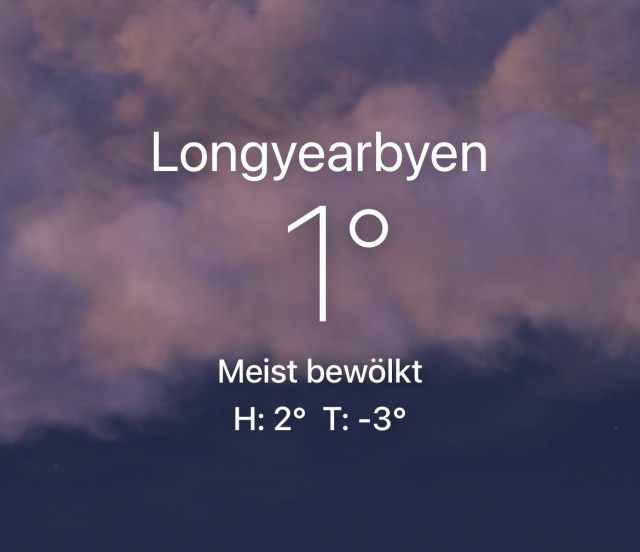
Welcome back to Bio On The Rocks. This week, there were above-zero temperatures and rain in Longyearbyen. Here, in the Arctic, in January! However, these mild temperatures often don’t last long. If sub-zero temperatures follow shortly thereafter, the melted water and rain freeze, creating thick layers of ice. The consequences of these “Rain on Snow Events” are, of course, that it becomes riskier for us humans to travel from A to B. Indeed, for the animals, it has an even greater impact. Reindeer and ptarmigans depend on the vegetation beneath the ice. The resulting ice layers prevent the animals from reaching it. The tragic consequence could be that the animals cannot consume enough food, build up an adequate fat layer, and lack sufficient protection from the cold in the very harsh months of February and March.

So, the above-zero temperatures and rain lead to the formation of unwanted ice layers. However, the unusually high temperatures due to climate change also result in ice melting in places where it should actually be present and where we expect it. Travelling on frozen waterways and fjords with snowmobiles is quite common up here. It’s not just a shortcut but often the only way to reach inaccessible areas of the island. Nevertheless, travelling on sea ice poses a considerable risk.
Some might think: “I can even ice skate on the local lake in Germany during winter. Why is it dangerous to move on ice in the Arctic?” First and foremost, I want to mention that it can definitely be hazardous to ice skate on frozen lakes in temperate latitudes, and one should always be aware of this danger. However, the crucial point is that sea ice has a different chemistry and structure due to the salt content in the water. Freshwater ice is much more compact and load-bearing due to the absence of salt.
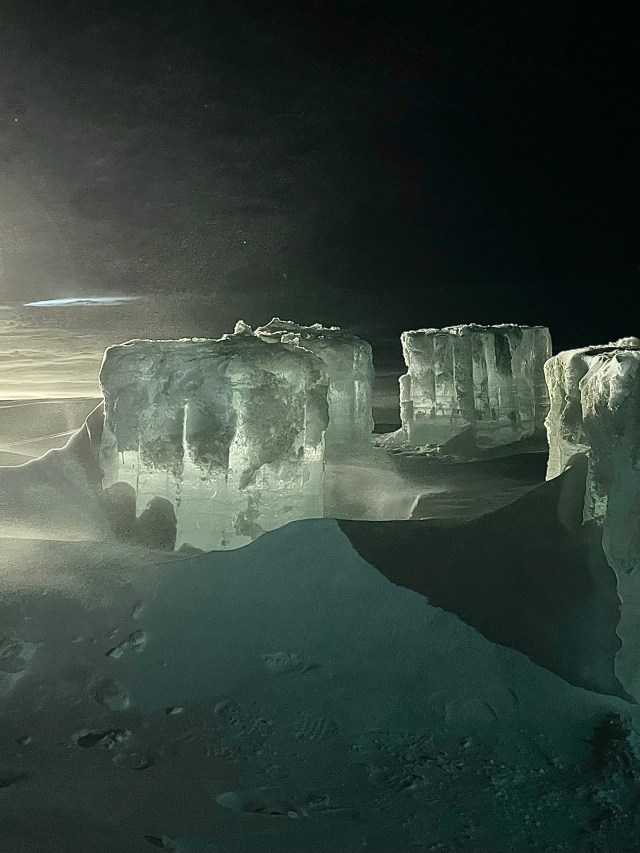
Sea ice is less compact, and it requires at least 10-20 centimetres to bear a person’s weight. Additionally, it only freezes at a temperature of -1.9°C. So, colder, longer-lasting, and more stable sub-zero temperatures are needed to form a sufficiently thick ice cover to move on it safely. As we can see, the fundamental conditions for thick sea ice are often unmet. Climate change further ensures that 100% safe movement on sea ice is never guaranteed.
I wrote last week about the warm ocean currents that continuously transport warm water to the west coast of Spitsbergen. The West Spitsbergen Current (WSC) is getting warmer each year. On the other hand, the smaller, cold polar current along the coast of Spitsbergen, acting as a barrier, is increasingly weakening. Consequently, more warm water flows into the fjords, significantly influencing the formation and preservation of sea ice.
Aside from that, some facts might leave an even greater impression. Due to the currents in Spitsbergen, there is generally a 10-15°C higher outside temperature than the average temperatures at these latitudes. Additionally, the impact of climate change in Svalbard is felt four times stronger than the global average. The onset of the melting season in spring starts 0.6 days earlier every year. This may not sound like much, but it means that compared to 1979, we now have about 20 days longer without ice in the year.
I believe my point is clear: The state of sea ice is generally bad, and especially here in Svalbard. But what does this mean for people who use sea ice as a transportation route? They need to be more cautious than ever before and be aware of the increasing dangers!
I will not tire of emphasising how crucial thorough preparation is to minimise the risk of ending up in such a situation. There are many things to clarify in advance. Where do we want to go? Which route do we choose? What are the local conditions? Has anyone been in the area recently that I could ask? Is there an alternative route? Who is accompanying us? Who is responsible for what on-site? What equipment does everyone have? How do we behave on the ice? What do we do if the conditions suddenly change? When do we decide to turn back? And, above all, does everyone know how to behave if someone falls through the ice?
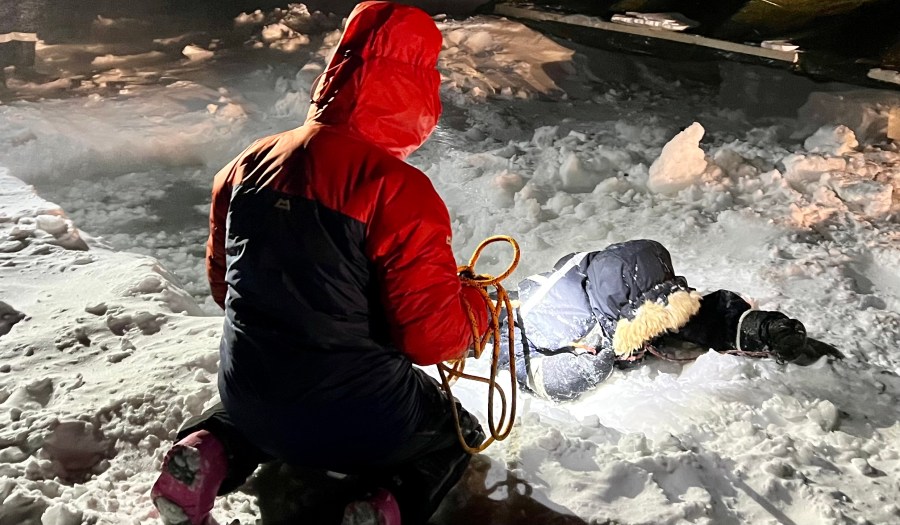
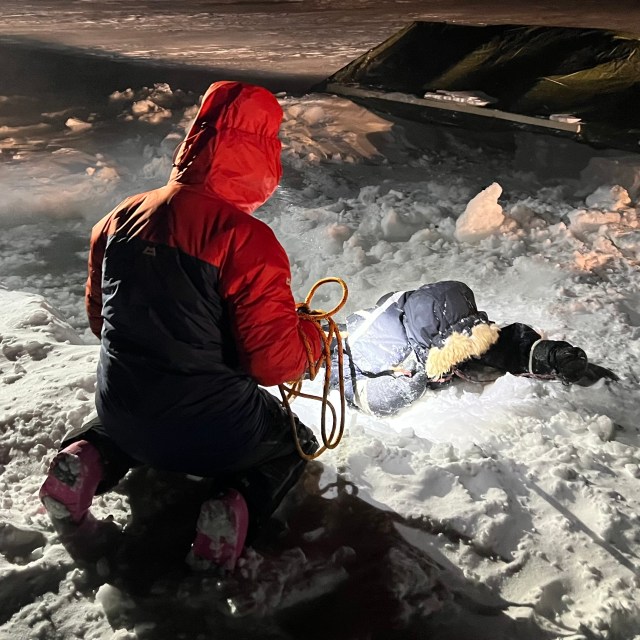
These questions can theoretically be answered but should only be trained under natural conditions. Therefore, this was also part of our training during the Safety Week. As mentioned, many times before, personal safety comes first. If someone actually falls through the ice, usually the first person in the convoy, all others must first make sure they are in a safe place. After a brief discussion, things must happen very quickly. One person volunteers to put on a waterproof plastic suit and is secured with a line by the others from the safe area. The rescuer goes to the distressed person and pulls them onto safe ice.
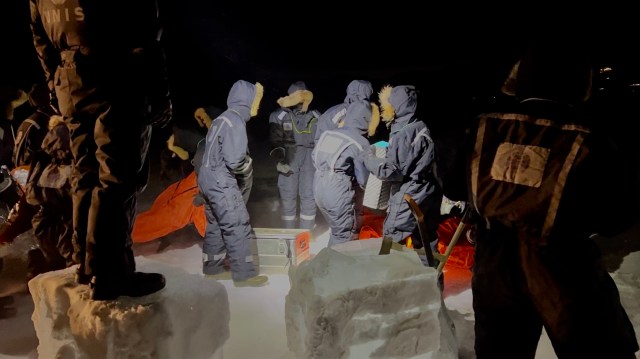
Meanwhile, the other group members have to prepare a so-called “Burrito.” This consists of an inner layer of a rescue blanket that retains the remaining body heat of the victim, a warming sleeping bag with an inserted isolating mat, and an outer layer as a windbreak. After the victim has been quickly and securely packed into the “Burrito,” an emergency call should be made. It is worth mentioning that this should only happen after the rescue unless you are part of a very large group. Communication via the satellite phone can easily take several minutes, precious minutes in which every hand is needed to rescue the victim from the icy water. While waiting for the rescue helicopter, the vital functions of the victim should, of course, be constantly checked. This massive shock to the body can manifest itself in ways other than just hypothermia.
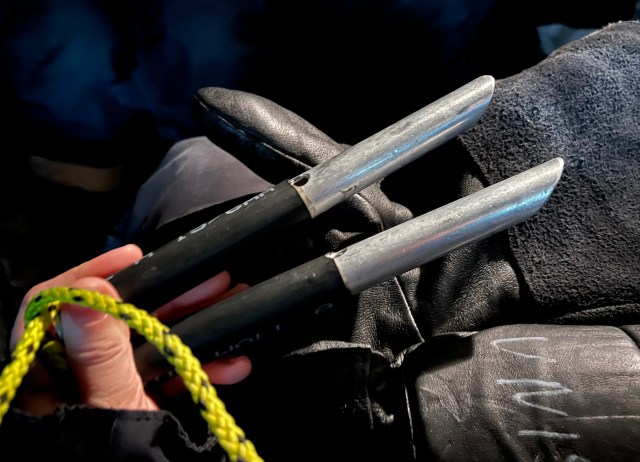
What do we do if, for some reason, we don’t have a supporting team that can rescue us from the ice? How can we free ourselves from the water? With ice spikes, the correct technique, maybe a certain resistance to cold, and, above all, the right mindset. The ice spikes, which everyone moving on sea ice should have in their chest pocket of the snowsuit, allow you to pull yourself at least a bit out of the ice. With a few powerful, precise leg kicks, you manage to get one knee onto the ice. If you succeed, you’ve got more than half the battle won. But what if it doesn’t work right away? If the cords of the ice spikes get tangled, the mittens are too big to grab them? And the water that seeps into the suit makes you increasingly heavy? The most important thing is not to panic and, in the truest sense, to keep a “cool” head.
That all sounds somewhat unsettling. At least, that’s how I felt, and I believe most of my fellow students felt the same way. The fact that we, as predominantly inexperienced students, were actually thrown into the cold water was something we all greatly respected during the Safety Week. However, the thorough training beforehand, the caring approach, and the encouraging words from our instructors provided us with the necessary confidence. This allowed everyone to dare and try themselves.
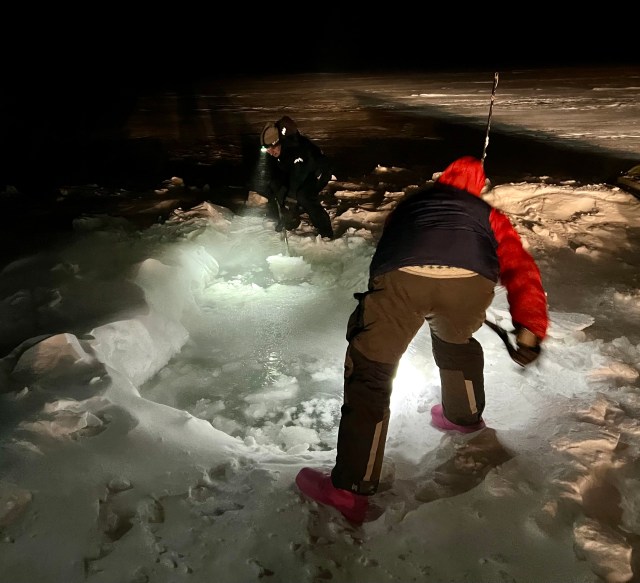
Everyone had the opportunity to step into the specially prepared ice hole, giving the freezing water a few seconds to seep into the thick suit, and then freeing themselves with ice spikes and the techniques we were taught. Of course, we were securely attached to a line at all times, and we were provided with the proper assistance when needed. Overall, I think that for most of us, self-rescue was not as challenging as expected.
Actually, we also practised rescuing another person. This means that in each safety group, a brave volunteer entered the water and was rescued by the others. Consequently, this included putting on the described, unwieldy plastic suit and preparing the vital safety burrito. Even after multiple dry runs, it took us 4 minutes to complete the rescue until our fellow student was warm. A time that was definitely not pleasant for the person involved. According to their accounts and also judging by their facial colour after 3 minutes in the icy water. I don’t want to imagine how such a situation would unfold if it caught someone cold and unprepared. Therefore, I am incredibly grateful that we had the opportunity to experience the scenario firsthand during the safety course.
But what about nature itself? What happens to it when there is less and more unreliable ice in the future? What happens to the polar bears and seals that move on sea ice? What happens to the microorganisms, fish, and whales below? What occurs with the entire marine ecosystem that depends on sea ice? These are questions to which I hope to provide some answers, at least in part, soon.
Stay safe, and remember, it’s all a matter of preparation and the right mindset!
 Bio On The Rocks